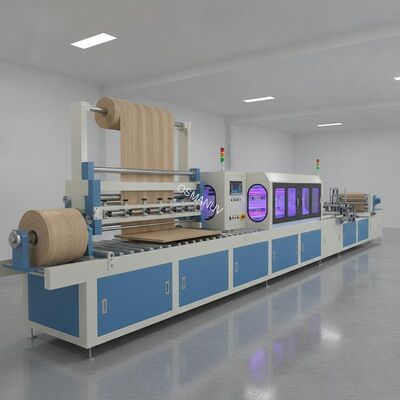
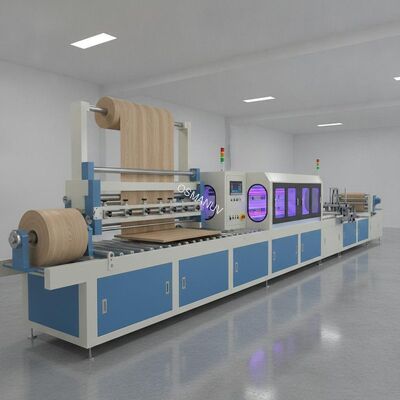
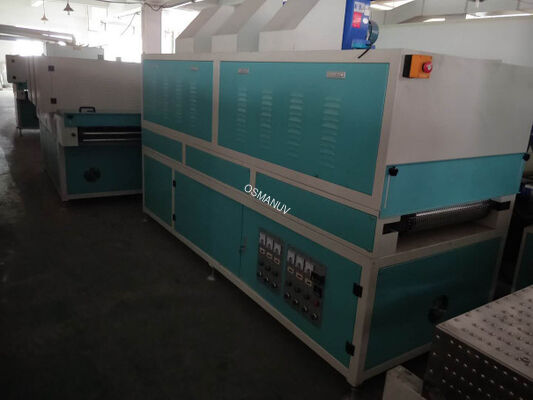
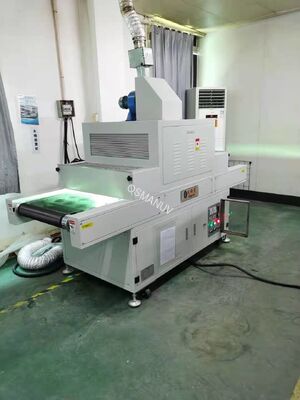
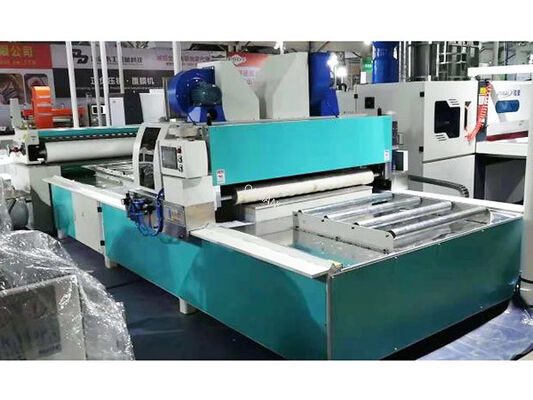
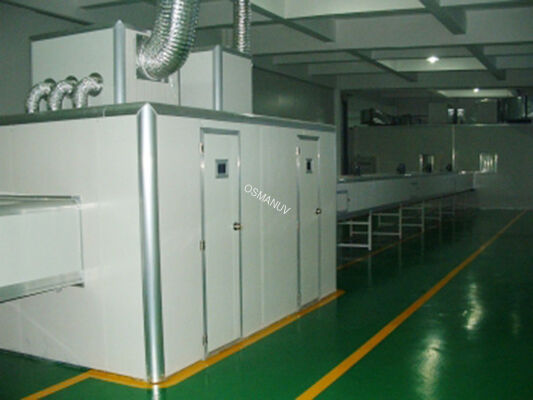
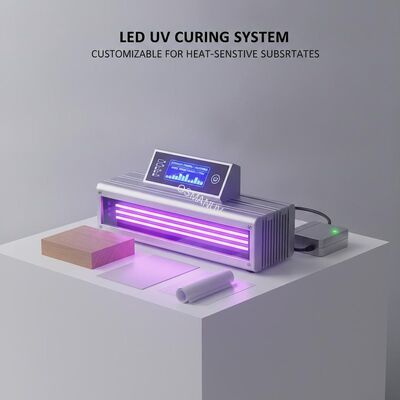
LED UV Curing System with Adjustable Intensity Profiles – Customizable for Heat-Sensitive Substrates (Wood/Plastic/Film)
LED UV curing system adjustable intensity
,UV curing machine for heat-sensitive substrates
,Customizable UV curing system for wood plastic
This customizable UV curing machine utilizes ultraviolet (UV) light to initiate photopolymerization, instantly curing UV-curable inks, coatings, and adhesives. Available in conveyor tunnel, LED cold-source, and spot/flood configurations.
The system is fully customizable in conveyor width, lamp type and number, wavelength, and automation level. UV curing offers significant advantages over thermal drying: faster cure speeds, lower energy consumption, minimal floor space (5-10 feet vs. 100-200 feet for thermal ovens), and environmental friendliness (typically 100% solids, no VOC emissions).
Working principle: UV light activates photoinitiators in the coating/adhesive, generating free radicals that trigger polymerization, converting liquid materials to solid state in seconds.
| Parameter | Conveyor Tunnel Model | LED Cold-Source Model | Spot/Flood Precision Model |
|---|---|---|---|
| Curing width (customizable) | Up to 72″ (1830mm) | Up to 1600mm | Spot: 5×5mm / Flood: 50×50mm |
| Conveyor speed (customizable) | 0 - 20 m/min | 0 - 30 m/min | N/A (batch/manual) |
| Lamp type (customizable) | Mercury arc / Metal halide / LED | LED (monochromatic, no IR) | LED / UV broad-spectrum |
| Wavelength options (customizable) | Full UV spectrum | 365 / 385 / 405 nm | 365 / 385 / 405 nm |
| Lamp power (customizable) | Up to 240 W/cm | Adjustable intensity profiles | Up to 600W flood |
| Cooling method (customizable) | Forced air / Water-cooled | Air cooling (no heat-sensitive damage) | Air cooling with cooler chamber |
| Control system | PLC + HMI touchscreen | PLC + multi-channel controller | Microprocessor + touchscreen |
| Substrate types | Sheets, panels, rigid substrates | Heat-sensitive: wood, plastic, film | 3D parts, electronics, small components |
| Power supply | 380V, 50/60Hz, 3-phase | 220V/380V, 50/60Hz | 110/220V, 50/60Hz |
- Printing industry: Screen printing, offset printing, flexo printing - ink/coating curing on paper, film, and packaging
- Wood finishing: Clear coats, varnishes on MDF, furniture, flooring - LED version ideal for heat-sensitive pine
- Electronics manufacturing: PCB UV ink curing, small component UV adhesive bonding
- Automotive: Body paint curing, scratch repair, wheel coating
- Medical devices: UV adhesive bonding of catheters, syringes, sensors
- Optics: Lens bonding, fiber optic cable securing, optical element assembly
- 3D printing post-processing: Post-curing of 3D printed parts
- Automated assembly: Integration with robotic arms for inline spot curing
This UV curing system is highly customizable to meet your specific production requirements:
- Curing width: Customizable from 6″ to 72″ (152mm to 1830mm)
- Lamp type: Mercury arc / Metal halide / LED - customizable per chemistry and substrate
- Wavelength: 365nm, 385nm, 405nm - customizable based on photoinitiator absorption spectrum
- Lamp configuration: 1, 2, or 3 lamps - customizable for different speeds and coatings
- Power output: 100W - 600W per lamp, infinitely variable control
- Cooling method: Forced air / Water-cooled - customizable for ambient conditions
- Conveyor belt: Teflon-coated fiberglass / Stainless steel mesh / Roller chain
- Control system: Manual / PLC with HMI / Remote monitoring via Ethernet (IoT-ready)
- Automation integration: Robotic arm mounting, press speed tracking, automatic power stepping
- Additional modules: IR pre-heating, dual-side curing (top+bottom), anti-static system
- Instant curing: UV curing happens in seconds - significantly faster than thermal drying
- Energy efficient: Consumes less energy than thermal ovens; LED version even more efficient
- Space-saving: Compact footprint - typically 5-10 feet vs. 100-200 feet for thermal ovens
- Environmentally friendly: 100% solids formulations - no VOC emissions, no solvent recovery needed
- High peak irradiance: Elliptical reflector delivers up to 20% higher UV intensity
- Heat management: Advanced cooling prevents substrate deformation (LED models emit no IR)
- Precise control: PLC with recipe management, automatic power stepping to match line speed
- Quick-change lamp cassettes: Minimizes downtime for lamp replacement
- Low maintenance: LED systems offer >20,000 hours lamp life, no warm-up time
- Safety features: UV interlock, emergency stop, lamp hour indicator
- Free process consultation - send us your substrate and coating for curing trials
- Custom layout design for your production floor
- On-site installation and commissioning (customizable support packages)
- Operator training program included
- Remote troubleshooting via video call, Ethernet diagnostics, or IoT monitoring
- 12-month warranty on mechanical components (consumables: lamps excluded)
- Spare parts availability from regional warehouses
- Lamp reconditioning and reflector cleaning services
- Lifetime technical support via phone, email, or chat
Packing: Anti-rust film + reinforced plywood case for main body and control cabinet; foam padding for fragile components (lamps, control panel)
Standard model lead time: 15-25 days after order confirmation
Custom configuration lead time: 30-50 days (longer for custom widths or multi-lamp configurations)
Shipping: FOB Shanghai / CIF by sea, air, or rail
Customizable: Export crating, custom labeling, destination port documentation
A: Mercury arc lamps produce a broad UV spectrum and are ideal for thick coatings requiring deep penetration, but generate significant heat and have shorter life (500-2,000 hours). LED UV systems are monochromatic (single wavelength), emit no IR (keeping substrates cool), are energy-efficient, offer >20,000 hours lamp life, and require no warm-up time. The choice is customizable based on your substrate and coating chemistry.
A: Yes. Our LED UV system emits no infrared radiation, making it safe for temperature-sensitive materials like pine wood, plastic films, and thin papers. For conventional UV lamps, optional water-cooled barriers and IR filter reflectors further reduce thermal load.